From Servers to Services
Modeling data centers as heat-active urban energy prosumers
Read the journal article at ScienceDirect
Article brief
This abridged blog version follows the manuscript structure: why data centers matter for urban energy systems, how the EPFL campus is modeled, what the heat-recovery scenarios test, and which results are most relevant for planning.
- Scale: EPFL campus district energy system with data-center demand, district heating, heat pumps, PV, batteries, and workload shifting.
- Method: multi-objective MILP using REHO, with representative days and Pareto exploration of CAPEX and OPEX.
- Main signal: data centers can become heat-active prosumers when cooling heat, district heating, PV integration, and flexible workloads are optimized together.
The basic shift
This paper starts from a practical observation: a data center is normally planned as an electricity consumer with a cooling requirement, but in an urban energy system it can do more than consume power and reject heat. If it is connected to the right infrastructure, a data center can supply useful heat, improve photovoltaic self-consumption, and use flexible workloads to align computing with local renewable electricity.
The case study is the EPFL campus in Lausanne. This is a useful test bed because the campus has data-center demand, building heat demand, district-heating infrastructure, heat pumps, photovoltaic potential, and a planned expansion of data-center capacity. The study models the data center not as an isolated IT facility, but as one component in a district energy hub.
The phrase “from servers to services” is doing real work here. The server is the physical asset. The services are heating, electricity balancing, local data processing, and renewable integration. The paper asks whether data centers can provide those services when their waste heat, cooling architecture, and workload flexibility are optimized together.
The modeling framework
The study uses REHO, the Renewable Energy Hub Optimizer developed by the IPESE group at EPFL. REHO is a mixed-integer linear programming framework for urban energy-system design and operation. It optimizes investments and operation across buildings, district infrastructure, energy conversion units, storage, and grid exchanges.
In this study, ICT is added as an end-use demand alongside electricity, space heating, and domestic hot water. That matters because data processing can then compete and interact with the rest of the campus energy system. The model includes electricity imports and exports, photovoltaic generation, district-level batteries, heat pumps, an Organic Rankine Cycle, district-heating thermal buffering, and data processing either in-house or through outsourced cloud services.
The temporal structure is built from representative days. Instead of solving all 8,760 hours directly, the model clusters the year into 14 typical days plus two extreme hours. The clustering uses solar irradiation, ambient temperature, grid carbon intensity, electricity purchase price, and data-center load. This gives the optimization enough temporal structure to see the mismatch between solar production, heat demand, electricity prices, and ICT workload.
The EPFL campus case
The campus is represented with existing and planned data-center infrastructure. The manuscript uses EPFL Research Computing Platform load profiles as a proxy for campus ICT demand and scales the profile to a 10 MW data-center size. A power usage effectiveness of 1.3 is assumed. Almost all electricity consumed by the data center is assumed to become recoverable heat, with 95% available and 5% lost to the cooling system.
The heating side is equally important. The campus district-heating network is modeled as a thermal buffer. Based on an estimated network layout, the water volume in the district-heating pipes is about 781 cubic meters, corresponding to a storage buffer potential of 18.2 MWh for a 20 degree Celsius temperature difference. That allows the model to shift heat within the day, charging the network when conditions are favorable and discharging during higher-cost periods.
This detail is one of the most interesting parts of the paper. Thermal storage is not only a tank added to the system. The existing district-heating network itself becomes a short-term storage asset, which changes how heat pumps and waste-heat recovery operate under dynamic electricity prices.
Two heat-recovery strategies
The paper compares two ways to use data-center waste heat, both assuming liquid-cooled data-center outlet heat at 75 degrees Celsius.
The first is a legacy heat-recovery strategy. In this setup, waste heat can be used directly for space heating and domestic hot water, or it can drive an Organic Rankine Cycle that generates electricity. The model chooses dynamically at each time step. In winter, when heat demand is high, direct heat delivery may be attractive. In summer, when heat demand is low, routing heat to the ORC for electricity can be more useful.
The second is an exergy-aware strategy. Here, the ORC is forced to operate continuously during data-center operation. The rejected heat from the ORC condenser is then used as a source for a secondary heat pump. This creates an ORC-heat-pump cascade. It is more complex, but it is designed to use the quality of the waste heat more carefully: first extracting electricity, then upgrading remaining heat through a heat pump.
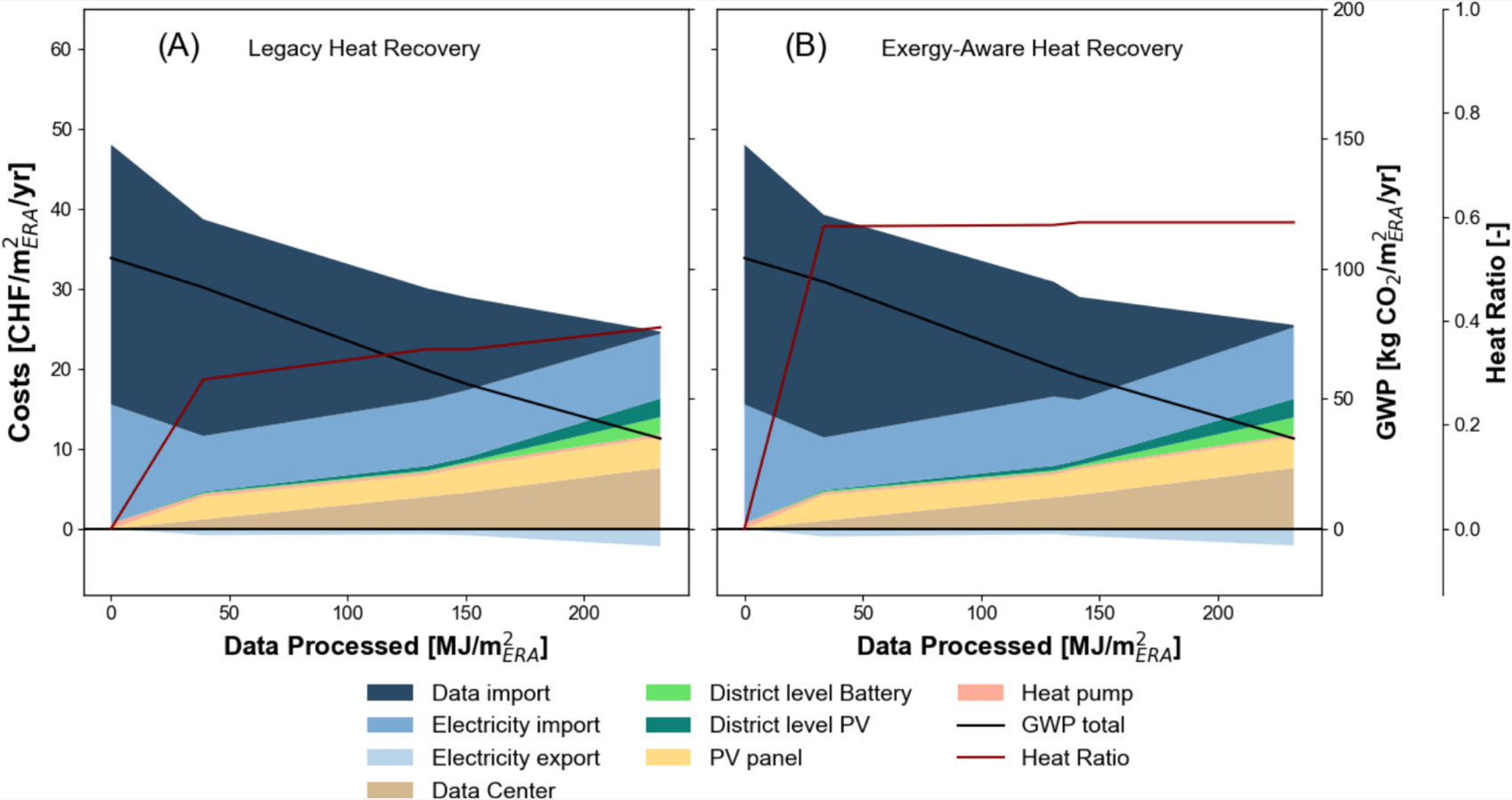
The comparison is not only about how much heat exists. It is about the usefulness of that heat. The manuscript introduces a heat ratio as a performance indicator that compares the exergetic value of useful outputs with the exergetic value of data-center heat input. In the exergy-aware cases, the heat ratio reaches about 0.6, compared with about 0.4 for the legacy strategy in the relevant grid-connected cases. This indicates that the cascade extracts more useful energy service from the same waste-heat stream.
Scenario design
The study tests five system scenarios. The business-as-usual case has no meaningful heat recovery: the campus uses its district heat pump and the data center rejects waste heat. The remaining scenarios vary three dimensions: grid connection, district-level PV integration, and workload flexibility.
The grid-connected fixed-workload case adds PV while keeping the data profile fixed. The grid-connected flexible-workload case allows the data profile to shift. The two off-grid cases remove grid electricity for the data center and examine fixed or flexible workloads under PV-only operation, with remaining data demand outsourced.
This structure makes the trade-offs visible. A grid-connected data center can reach full data self-sufficiency because electricity is available when PV is not. An off-grid data center is more constrained and must outsource more work, unless flexibility helps it follow solar production.
Workload flexibility as an information battery
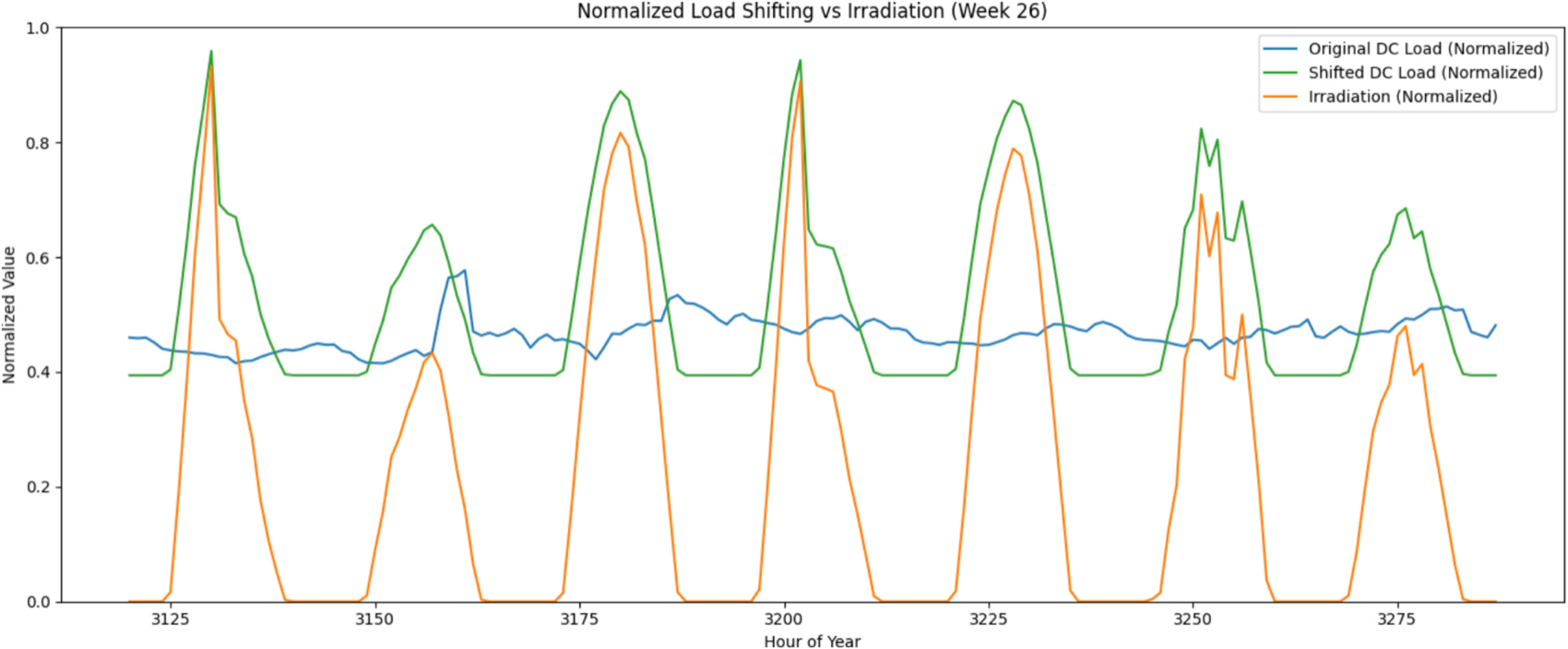
The manuscript uses real campus workload profiles, but recognizes that not all data processing is urgent. Based on literature values, the study assumes a conservative 30% shiftable share of workload within a 24-hour horizon. The total daily workload is conserved, but its timing can shift to better match solar irradiation and electricity prices.
This is where the “information battery” idea enters. Instead of storing surplus solar energy physically, the data center can process flexible workloads when solar electricity is available. In the model, flexible workloads improve the temporal alignment between PV generation and data-center demand. That increases photovoltaic self-consumption and reduces export or curtailment.
The reported results show that flexible workloads can raise PV self-consumption up to 90% in the flexible cases. In the fixed workload case, PV self-consumption is lower because demand does not naturally align with solar availability. The flexible strategy also reduces the amount of PV capacity needed per unit of data-center capacity: from roughly 8-9 units in fixed-workload scenarios down to about 5.2 units as data-center size increases in flexible cases.
Main results
Several findings stand out.
First, data centers can materially contribute to campus heat. In selected scenarios, the data center can supply up to 40% of the campus district-heat demand. This is not just an energy-efficiency claim. It changes the role of the data center in campus planning: cooling heat becomes a district resource.
Second, the district-heating network has real operational value as a short-term thermal buffer. The model charges and discharges the network in response to electricity tariffs and heat demand. This means the heat network can support cost minimization and emissions reduction even before adding large dedicated thermal-storage systems.
Third, exergy-aware heat recovery performs differently from direct reuse. The ORC-heat-pump cascade generates more electricity through the ORC and supplies more heat via the data-center-linked heat pump, while the legacy strategy relies more heavily on direct heat delivery and district-level heat pumps. The exergy-aware approach is more thermodynamically efficient, but also more infrastructure intensive.
Fourth, workload flexibility changes both PV use and data-center sizing. In grid-connected flexible cases, the model may oversize the data center to process more work during favorable periods, reducing operational expenditure but increasing capital cost and embodied emissions. This is a critical trade-off: flexibility improves renewable utilization, but it can increase peak capacity requirements.
Fifth, off-grid operation remains difficult. Even with flexible workloads and oversized local infrastructure, the off-grid flexible case reaches only about 60% data self-sufficiency, compared with about 45% in the off-grid fixed case. The rest must be outsourced. This is not necessarily a failure, but it shows that local autonomy has limits unless it is paired with geographic coordination and abundant renewable availability.
Policy and planning implications
The paper argues for treating data centers as active urban energy nodes. For cities and campuses with district heating, data-center siting should consider nearby heat demand, heat-network access, cooling technology, and the possibility of modular thermal coupling. A facility placed near useful heat sinks can provide value that an isolated facility cannot.
The study also points to the need for better information from data-center operators. Without transparency on energy sourcing, workload distribution, infrastructure, and outsourcing, it is difficult to account for emissions or plan district integration. This is especially relevant for Scope 3 emissions associated with digital services and imported cloud processing.
Finally, flexibility markets should recognize digital flexibility. Data centers can provide demand response through workload scheduling, cooling control, and potentially other operational resources. But that requires coordination among data-center operators, distribution system operators, transmission system operators, renewable-asset managers, and heat-network planners.
Takeaway
The paper’s main contribution is not just that data-center waste heat can be reused. It is that heat recovery, workload flexibility, PV integration, district-heating buffering, and data self-sufficiency need to be optimized together. At EPFL campus scale, the data center becomes more than a server room: it becomes a prosumer whose design affects heat supply, electricity exchange, capital investment, operating cost, and emissions.