Workload-Flexible Data Centers Reduce Renewable Curtailment
What changes when Europe’s net-zero models treat digital infrastructure as electricity demand, recoverable heat, and flexible compute?
Read the journal article at Cell Press
Article brief
This abridged blog version follows the manuscript logic: project European ICT demand, place it inside a 2050 net-zero energy-system model, represent recoverable heat and workload flexibility, and interpret the system consequences.
- Scale: EU-27, United Kingdom, and Switzerland in 2050 net-zero energy-system scenarios.
- Method: Monte Carlo ICT-demand projection, country-level spatial allocation, EnergyScope-EU optimization, and MGA exploration of near-optimal designs.
- Main signal: flexible computing reduces renewable curtailment, but requires coordinated operation and higher peak ICT capacity.
Why this paper matters
Data centers are often added to energy-system models as a block of extra electricity demand. That is useful as a first approximation, but it misses the main reason digital infrastructure is becoming system relevant. Data centers are not only loads. They are geographically concentrated electricity consumers, continuous producers of low-temperature cooling heat, and operators of workloads that are not always time critical.
The paper starts from that gap. Europe’s net-zero pathway depends on very large amounts of variable renewable electricity, especially wind and solar. As the share of variable renewables rises, system planning becomes less about annual energy alone and more about timing: when electricity is generated, when demand occurs, when storage fills, when curtailment appears, and where flexible demand can absorb renewable peaks.
At the same time, computing demand is expanding. Cloud services, data-intensive applications, and AI workloads increase the scale of data-center electricity demand. Many of these workloads are not perfectly rigid. Batch analytics, backups, and parts of AI training can be delayed or shifted without necessarily degrading user-facing services. The manuscript therefore asks a planning question: if Europe is going to host substantial data-center demand in 2050, what happens when that demand is represented as a flexible, heat-producing part of the energy system?
The modeling chain
The study builds the analysis in three steps.
First, it constructs a Monte Carlo envelope for 2050 ICT activity. The projection is anchored in recent global data-consumption observations and extended to 2050 with exponential growth and multiplicative uncertainty. The point is not to claim one exact future for digital activity, but to expose a transparent range of possible ICT demand trajectories. In the central European scenario, the resulting data-center electricity demand reaches about 667 TWh/year in 2050, around 7.9% of final European electricity demand.
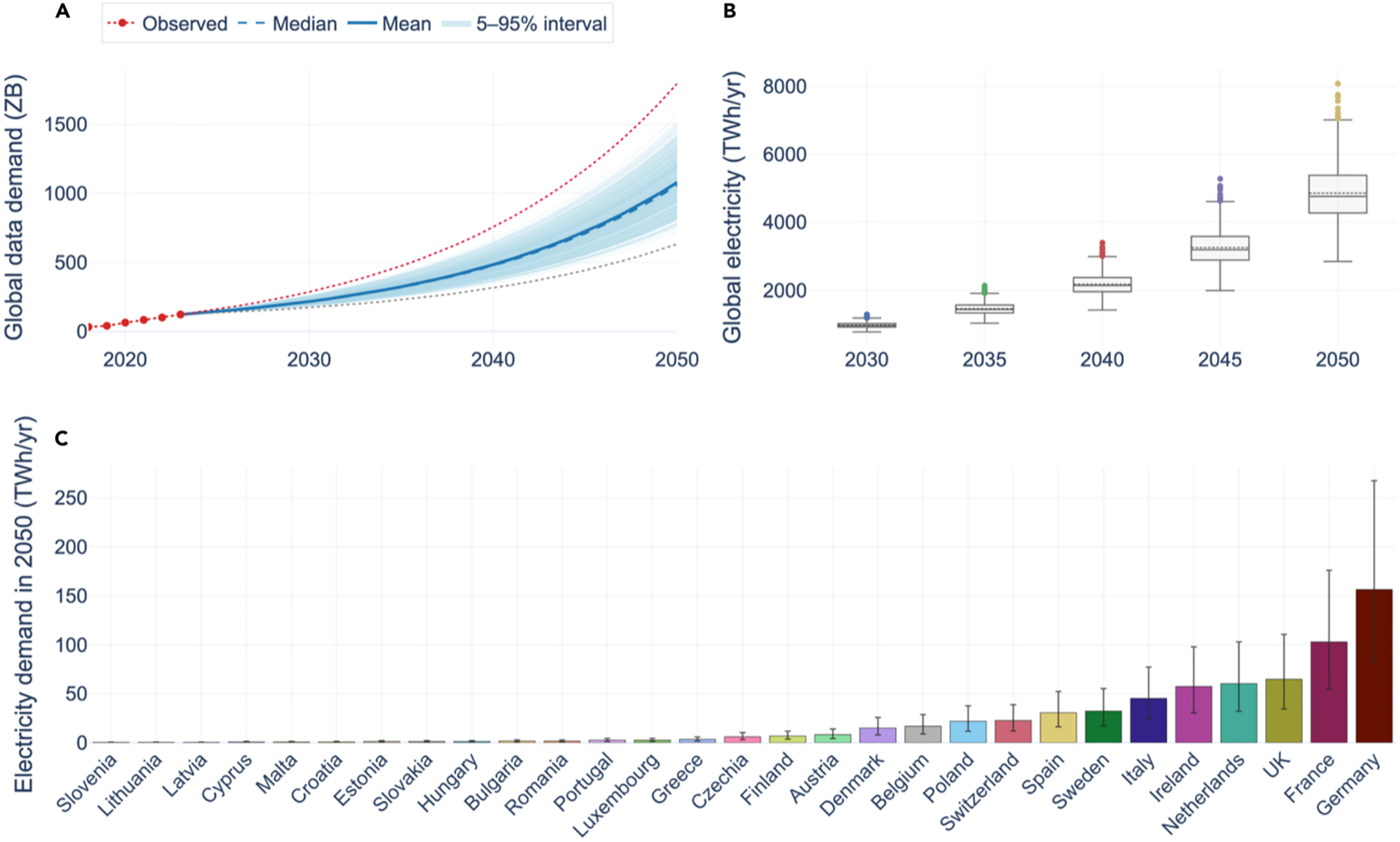
Second, the global demand envelope is downscaled to European countries using present-day data-center activity shares. This keeps the spatial concentration of existing digital hubs visible in the model. Countries such as Germany, France, the United Kingdom, the Netherlands, and Ireland become especially important because data-center activity is not evenly distributed across Europe. The manuscript treats this as a path-dependent baseline, not as an optimal siting forecast. Policy, electricity prices, grid constraints, and interconnection rules could move future data centers elsewhere.
Third, the country-level ICT demand is embedded in EnergyScope-EU for the EU-27, the United Kingdom, and Switzerland. The model is extended to represent data centers as electricity demands, potential low-temperature heat sources, and partially flexible workloads. The study then uses modeling-to-generate-alternatives, or MGA, to examine 100 near-optimal 2050 system designs under a 20% cost slack. This matters because a single cost optimum hides the range of plausible infrastructures that can meet the same net-zero constraint.
What changes in the European energy system
Adding explicit ICT electricity demand reshapes the near-optimal design space. Data-center demand is mostly electricity-only and not easily substituted by another carrier. That makes it a direct pressure on the power system. The manuscript reports a wide corridor of possible 2050 technology portfolios: wind capacity varies strongly across solutions, PV also changes substantially, while firm low-carbon options and storage remain important in different ways depending on the objective.
The MGA results are useful because they show that Europe is not pushed into one unavoidable system architecture. There are several near-optimal ways to serve the same demand. Some solutions lean more heavily on renewables and storage; others preserve more firm generation. Transmission reinforcement is comparatively stable across solutions, suggesting that grid expansion remains a robust requirement even when the technology mix changes.
The heat side is more spatially constrained. The model estimates up to 243 TWh/year of recoverable low-temperature cooling heat from data centers in Europe, about 5% of projected continental low-temperature heat demand. But this heat is only useful where there are urban loads, district-heating networks, and suitable temperature conditions. The manuscript is careful on this point: recoverable heat is not automatically usable heat. Its value is concentrated in district-heating-ready urban areas.
Workload flexibility as the central lever
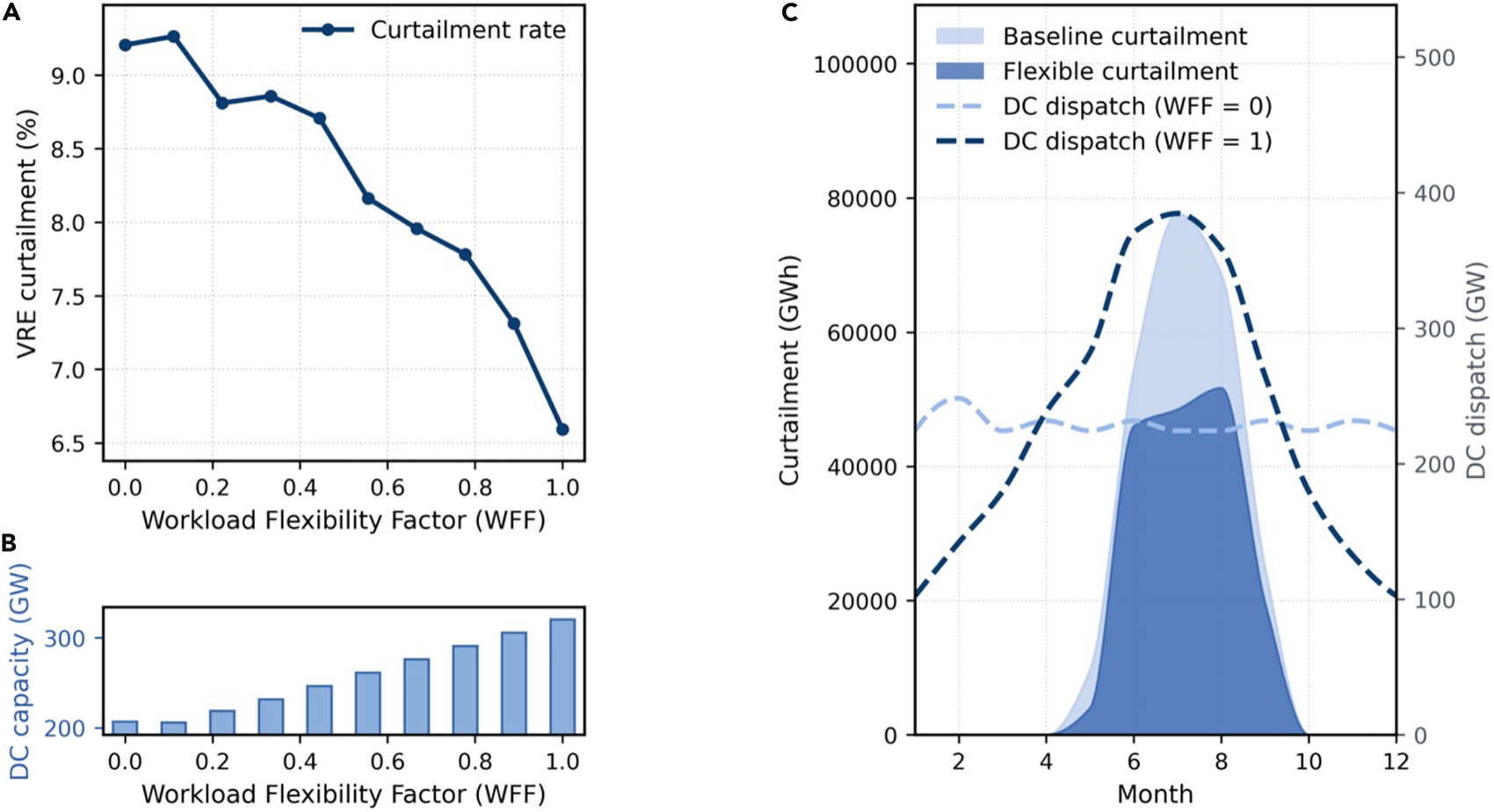
The strongest operational result comes from workload flexibility. The paper defines a workload flexibility factor, WFF, ranging from 0 to 1. At WFF = 0, data-center load is treated as largely inelastic. At WFF = 1, the model represents an upper-bound case in which the deferrable share of computing can be shifted or geographically migrated toward renewable-rich periods.
Annual computing demand is conserved. The model does not reduce the amount of computing. It changes when flexible work is processed. That distinction is important because the result is about coordination, not demand destruction.
As WFF rises, European renewable curtailment falls. The manuscript reports a decrease from just over 9% in the inflexible case to about 6.5% in the fully flexible benchmark. That is a reduction of roughly one third in curtailment rate at European scale. The mechanism is straightforward: data centers execute more deferrable work when wind and solar generation are abundant, absorbing electricity that would otherwise be curtailed.
The trade-off is peak capacity. If the same annual workload is compressed into renewable-rich windows, data centers need more installed ICT capacity. The study therefore does not present full flexibility as a free operational trick. It is a benchmark for what coordinated temporal shifting and geographic workload migration could achieve if the physical ICT capacity, interconnection rules, and operational incentives exist.
Distributional consequences
The country-level results show that objective choice matters. A cost-minimum system, an emissions-minimum system, a regional-inequality-minimum system, and a renewable-maximum system distribute costs, renewable build-out, and residual emissions differently across Europe.
Large load centers remain important across the scenarios. Germany and France repeatedly sit in high-cost and high-impact regions of the country-level analysis because they combine large energy systems with large ICT demand. Italy, Spain, and the United Kingdom also appear prominently depending on the objective. This is one of the more policy-relevant outcomes: digital infrastructure reinforces existing spatial pressures in Europe’s energy system unless siting and flexibility are deliberately governed.
The analysis also shows that data-center heat recovery cannot be treated as a uniform European resource. Countries with established district-heating networks and urban heat demand can extract more value. Countries without those networks would need new infrastructure before recoverable cooling heat becomes a meaningful decarbonization lever.
What the paper does not claim
The manuscript is explicit about scope. It does not model every operational constraint inside a real data center. It does not resolve latency requirements, service-level agreements, sub-hourly congestion, UPS dispatch, cooling-control details, or specific market rules. EnergyScope-EU uses representative time slices and is built for strategic system design, not facility-level operations.
The demand projection is also intentionally transparent rather than technology deterministic. The conversion between data consumption and electricity use is used as a baseline, not as a claim that computing efficiency stays fixed to 2050. Future chip efficiency, cooling technology, utilization, AI model design, and workload management could all change the envelope.
Those limitations do not weaken the central conclusion. They define what the result should be used for: strategic planning. The paper shows that omitting data-center electricity, heat recovery, and workload flexibility can hide meaningful system effects in net-zero energy planning.
Policy reading
The policy implication is that data centers should be governed as grid-interactive infrastructure. That means planning rules should not stop at power-usage effectiveness or procurement of clean electricity on an annual basis. They should consider where facilities connect, whether heat recovery is feasible, whether UPS and cooling systems can provide flexibility, whether workloads can respond to renewable availability, and how operators are compensated for doing so.
The manuscript points to a coordination gap. Energy-system operators increasingly need flexibility, while data-center operators often optimize private reliability and low facility energy overhead. Without market products and planning rules that make system-friendly operation valuable, data centers may be built in ways that minimize local operational risk while missing larger grid and heat-system benefits.
Takeaway
The paper reframes data centers as system variables. In a renewable-heavy Europe, the important questions are not only how much electricity computing will consume, but where data centers are located, when deferrable workloads run, what peak ICT capacity is needed, and whether urban heat networks can use the cooling heat. Once those questions enter the model, digital infrastructure becomes part of the net-zero design problem rather than an external load added at the end.